
TV interview with Deutsche Welle (DW) News on the political outlook for the Iran protests in 2026

I gave an interview to Deutsche Welle (DW) News on 02 January 2026 on the demonstrations in Iran. You can watch the full video above. In the meantime, I have elaborated on the points I made in the interview below based on new developments.
We discussed how the continued decline of the rial triggered the protests in and around Tehran’s Grand Bazaar and the Iranian capital city’s central commercial hub, mainly fueled by the long-term effects of US and international sanctions, as well as the Islamic Republic’s economic mismanagement and systemic corruption.
The protests have quickly escalated since the first day (they are now in their ninth day) to become about much more. Most protests slogans as captured in videos from across Iran disseminated by foreign-funded diaspora media and opposition groups clearly and unequivocally call for the overthrow of the Islamic Republic. The rapid jump from economic trigger to anti-system protests is a function of the failure of the Islamic Republic to deliver positive outcomes across a wide set of issues resulting in a multiplicity of crises-a “polycrisis”-in Iran on a range of domains: Economic, socio-cultural, environmental, security, etc.
These protests may well be suppressed by the ruling system-perhaps by the end of this week. The last three such anti-system mass demonstrations-in December 2017/January 2018, November 2019, and September to December 2022-were crushed after weeks or months. Confronted by the Islamic Republic’s united political elites and cohesive security forces, unarmed and disorganized protesters have little chance.
In fact, reflecting on the moments during which Iran’s political system partially transformed or changed altogether over the last century or so of Iranian history, rarely were mass uprisings the decisive factor. Foreign intervention and military and elite action and defection were often more important, with mass uprisings sometimes coming after the determining moment had already passed. Even during the Islamic Revolution of 1979, Mohammad Reza Shah Pahlavi first had to effectively surrender, and the Iranian Army declare neutrality, before the Ayatollah Ruhollah Khomeini-led mass uprising could succeed, otherwise it may have turned out differently.
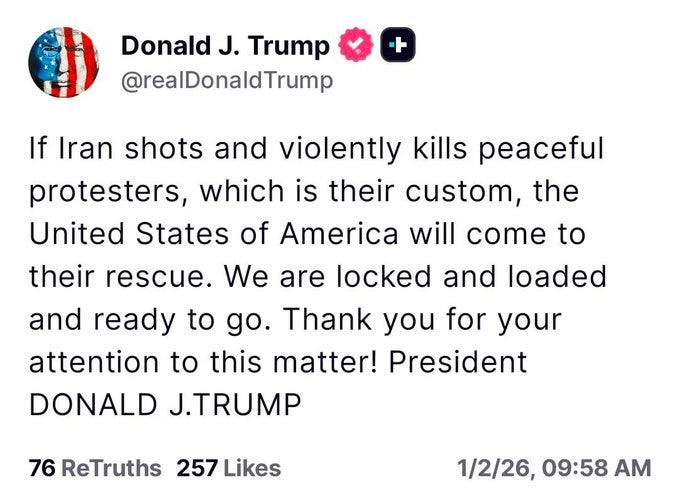
The prospects for the success of these protests in overthrowing the Islamic Republic, if history is anything to go by, therefore look grim. But three important points should be kept in mind. First, some event may take place that further fuels and facilitates these protests into the next stage. This could include a decision by US President Donald J. Trump to enforce the apparent redline that he set down for the Islamic Republic against violently killing peaceful Iranian protesters, although this could backfire if the ruling system decides to escalate violence on protesters in response.
Second, this round of protests is notable for the emergence of a large volume of slogans related to a desire by many protesters for Crown Prince Reza Pahlavi-the son of Mohammad Reza Shah Pahlavi-to take leadership of Iran. The Pahlavi movement’s growing strength and popularity-a trend that I explored in a long thread on X back in June-may be an indication that the leadership vacuum that has plagued anti-system mass demonstrations since they emerged in December 2017/January 2018 may be being filled, pointing to the possibility of a better organized opposition and protest movement in the future.
Finally, the Iran protests in December 2025/January 2026 are the fourth anti-system mass demonstrations in about eight years-averaging about one protest every two years. Although these protests have had varying economic and socio-cultural triggers,1 their persistence and cyclical nature points to them being a structural feature of the domestic politics of the late-Second Islamic Republic under Leader Ayatollah Ali Khamenei. The conclusion we can draw from this is that, if conditions in Iran-especially economic ones-continue to deteriorate in 2026, such protests are likely to erupt again, perhaps under conditions more conducive to their success, at least absent far-reaching changes by the ruling system.
The anti-system mass demonstrations in December 2017/January 2018, November 2019, and December 2025/January 2026, were primarily triggered by economic factors; the protests from September to December 2022 were mainly caused by socio-cultural factors, beginning with the arrest and killing of Mahsa Amini over a perceived violation of the mandatory hijab.
The Architecture of a Crisis Manufactured by Hostile Foreign Powers.
An exclusive exposé on the hidden forces, intelligence networks, and propaganda machinery fueling turmoil in Iran. https://felixabt.substack.com/p/the-architecture-of-a-crisis-manufactured